

Written by: David Tucker, Bikepacking Roots Board Member
A bobcat kitten and its mom, following the path of least resistance in the same way that I am, visible only in the paw prints left in the desert dirt. Coyotes, perhaps hoping for a carcass to scavenge, out of sight but within earshot, betrayed by their signature yips. Sharp-eyed raptors, surfing the thermals, silent but no doubt deadly as they harness the power of the wind to pursue their prey.
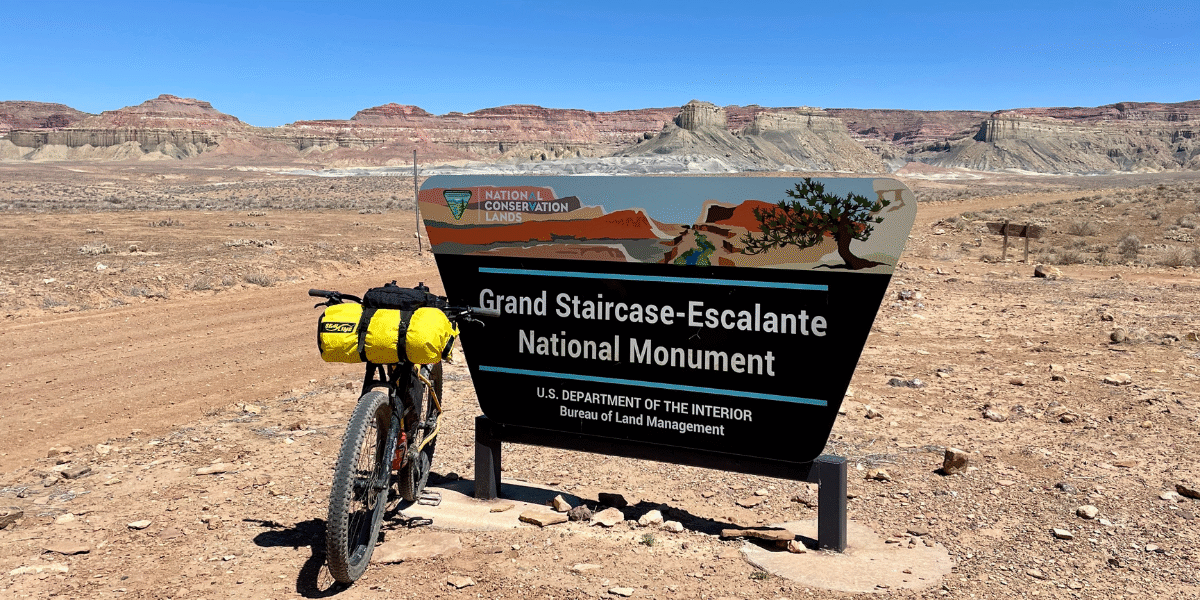
These are my companions for three days in Grand Staircase Escalante National Monument, a vast and diverse landscape in southern Utah covering almost two million acres of public land. While I pedal my way along Bikepacking Roots’ High Plateaus Loop, these critters are about the only company I have.
I’m here for no reason other than curiosity, but the trip took on new significance when the Trump Administration announced it was yet again considering rescinding protections for this enchanting landscape. On February 3, Secretary of the Interior Doug Burgum released SO 3417, which among other things called on federal agencies to determine lands within their jurisdictions for potential resource development, particularly energy to rectify our “national energy emergency”. (It should be noted that the United States is currently producing more energy than at any other time in its history and is the largest oil and gas producer on Earth.)

To many, this was setting the stage for monument reduction, the energy emergency and national security concerns providing the justification. This was the second time in as many administrations that Trump has looked to reduce Grand Staircase, and in December of 2017, he successfully cut the monument in half, while simultaneously decreasing Bears Ears National Monument by 85 percent. That decision faced legal battles and when elected President in 2020, Joe Biden reinstated the original boundaries.
While Burgum’s SO 3417 was vague in its language, a recently leaked internal DOI document was much more specific, naming six national monuments the administration is targeting for reduction. My destination is on that list, along with lands included in several other BPR routes, but at the moment I am blissfully unaware. The climb I am currently attempting demands my full attention, and my winter-weakened legs are begging for mercy.
I relent in the shade of a cottonwood, fishing through my trail mix for the M&Ms and pulling long and hard on my water. I plan to refill in the creek running at a trickle even at this early spring date, but there is just enough and I’m grateful, because the calendar notwithstanding, it’s hot and dry compared to the relative water-world of southwest Montana where I live.
Along the streambank, green shoots emerge through the sand and an unidentified bird leaves footprints near the water’s edge. A well-fed squirrel scurries among the rock formations, time-traveling from one eon to the next as it moves from cache to cache, up and down the canyon walls. Quads adequately placated, I move on with daylight fading and miles to go before I sleep.
The next morning, I roll mostly downhill into the small town of Escalante, where I am thrilled to see Escalante Outfitters open for business on this Easter weekend. Pizza, a pint of beer, more sunblock, and a map-check with the owner. Her husband is an avid bikepacker and I am happy to confirm that the route is issue-free, although she encourages me to drink several cups of water and fill up all my bottles before leaving, which I do after having the lion’s share of a large pepperoni and wrapping the leftovers.
In Escalante, the economic importance of the monument is undeniable, as most Main Street businesses are dedicated to lodging, guiding, or supplying tourists with the requisite gear for safe and enjoyable exploration of the backcountry environs. This is basecamp for the northern part of Grand Staircase, and visiting families shuffle in and out of the shop, fueling up before heading out.
Economics is one justification for a national monument. There are others. Tribal sovereignty, biological diversity, ecological integrity—the list is long and shouldn’t be ignored. Many people value this place for many reasons, and recent public opinion surveys reject efforts to reduce its size.
Back in the saddle, as I wind my way up Collet Creek, it is easy to see why. Hole-pocked sandstone cliffs recall melting wax figurines and vanishing drip-drip castles. Dense piñon pine forests tower above, reminding me that I have much work to do, although at the moment I am content to slouch along at a near-snail’s pace, my attention drawn from one impossibly stacked rock formation to the next. A boulder perfectly bisected by an almost level vertical crack. House-sized rocks perched atop a stack of eroding sandstone disks no bigger than dinner plates. So many shades of red.

Back on the plateau, views expand in every direction for miles. Absent from the scene is any indication of the human built environment, apart from the road on which I ride. No visible cell towers. No transmission lines or oil rigs, or wind farms or solar arrays for that matter. Not even a house on a hill.
There are few places like this left on Earth, and fewer every day. Up here, things go about their business, as they have—and hopefully will continue to do—forever. This is a bit of an illusion but one I am happy to indulge as the sun makes its way toward the western horizon and I begin to scout for a campsite.
Once darkness falls and Orion appears in the fading light, I tidy camp and retire to my bedroll. Looking up, the enormity of the place is apparent once again as innumerable stars enter stage right. After a long day, sleep comes quickly.
At dawn I pack up and roll out, slowly wending my way back to my vehicle, cell service, and the news that all this could soon go away. I went into the ride knowing there were designs on reduction, but the confirming headlines are still a kick in the shin.
Before sinking into despair, I see opposition is already mobilizing. Bikepacking Roots staff and board are engaging behind the scenes with partner organizations, connecting with the delegation in New Mexico on monuments in that state, and activating membership to prepare a strong defense against any official orders that may be announced.
This advocacy will be critical to amplify the varied voices that support these places, Grand Staircase and others across the country. Public lands protection and access have bipartisan appeal, perhaps the last issue that enjoys such a distinction, and top-down decision making should be countered by popular opinion and solutions that work for locals and small businesses.
As of May 14th, no reduction plan has been publicly released, but it seems to be a waiting game at this point. The Trump Administration has thus far shown that they should be taken at their word. If they say they want to do something, it is clear they believe they have the political cover to do it, even if it is broadly unpopular.
For now, those of us that value these places, for whatever reasons, whether up close or from afar, should be ready to act on their behalf. Soon, these lands will need us to speak up for them, and we hope you’ll join the chorus.
Take Action today to protect our cherished National Monuments: https://monumentsforall.org/action/
Consider supporting Bikepacking Roots’ advocacy work by becoming a monthly donor: https://bikepackingroots.org/monthly-donors/
Thanks to our 2025 Business Partners:
